

As home educators, we’re always trying to find a rather interesting balance. We want enough structure to know we’re moving forward, but not so much that we lose the freedom that made us choose home education in the first place.
We want a sense of direction and the reassurance that the things that matter aren’t quietly being forgotten. But we also want room for the child: their interests, their capacity, the unexpected rabbit trail that becomes the best learning of the week, the slower day, or the project that takes three times longer than expected because they’re completely absorbed in it.
That balance has always been at the heart of Freely homeschool planner. We want the planner to hold the learning, not control it — to provide a container for your child’s journey without trying to decide exactly what that journey should look like.
Enough structure to help you keep moving forward, and enough flexibility to let homeschooling still feel like homeschooling.
The latest changes we’ve made to Freely bring that idea together more clearly than ever.
.png)
We still begin with the child
Before the week, the subjects or the curriculum, Freely begins with the learner.
Our updated Student Profile now gives you more space to capture who they are, including their interests and the goals they’re working towards. That’s deliberate, because it’s very easy for planning to slowly become about the stuff: the curriculum, the lessons, what needs to be finished and what hasn’t been finished yet. Meanwhile, underneath all of that is an actual child having an education.
Their interests are part of that. Their goals are part of that. The way they learn, the amount they can hold and the season they’re in are part of that too.
We don’t want the learner to disappear underneath the plan. We want them to remain at the centre of it.
And this is only the beginning of what we see the Student Profile becoming. We’re working closely with some of our founding Freely members to explore how goals, interests and the learner themselves can become much more meaningfully connected to the way families plan, reflect and make decisions inside Freely.
We don’t want this to become another collection of information you fill in and forget about. The bigger vision is for what you know about your child to genuinely help shape their learning journey.
Plan the rhythm first. Add the details later.
After spending a little time thinking about your child — their interests, their goals, what they’re working towards and what makes them light up — you come into planning looking through a different lens.
And that is very deliberate from a design perspective.
Instead of arriving at an empty week and immediately asking, What do I need to fit in?, your child is already at the forefront of your mind. You’re thinking about their capacity, the season they’re in, what matters to them, and what a realistic week might actually look like.
That’s where Routine comes in.
You’re not trying to predict every individual lesson yet. You’re simply creating a rhythm around this particular learner. Maths and Language Arts might happen most days. History might sit on Monday and Thursday. Wednesday might deliberately be lighter because you’re out of the house, or because you know this child needs more space in the middle of the week.
When you create or adjust that Routine in Edit Mode, you’re setting the broad shape of their week before filling it with all the detail.
The result is a plan that begins from a much more realistic place.
Plan the rhythm first. Add the details later.
You’re still giving the week direction. You’re still moving forward. But instead of filling an empty calendar and hoping your child can carry it, you’re creating a container for their learning with them already firmly in mind.
Then, when you move into My Week, you can start adding the learning itself.
Different kinds of learning need different kinds of planning
Not everything in a homeschool needs to be planned to the same level of detail.
Sometimes you need one sentence: Complete Lesson 12.
Sometimes you’re working through a larger Project and want to bring the next lesson into the week.
And sometimes you know what subject you want to focus on, but you’d like to see what you already have available before deciding exactly what to do.
So when you add an activity in Freely, you can now type a quick activity, choose a lesson from one of your existing Projects, or explore relevant resources from the Project Import Library.
That flexibility matters, particularly for families who don’t homeschool in one single way. You might use a structured maths curriculum, literature for Language Arts, projects for History, interest-led Science and spend Friday at an excursion.
That isn’t an untidy version of homeschooling. That is homeschooling for many families.
Good planning shouldn’t force all of those different kinds of learning to look the same.
Let the week move with you
Even the most thoughtful Routine still has to meet real life.
Someone needs longer than expected. An appointment comes up. An excursion replaces the morning you thought you’d have at home. A child becomes completely absorbed in something you hadn’t planned at all.
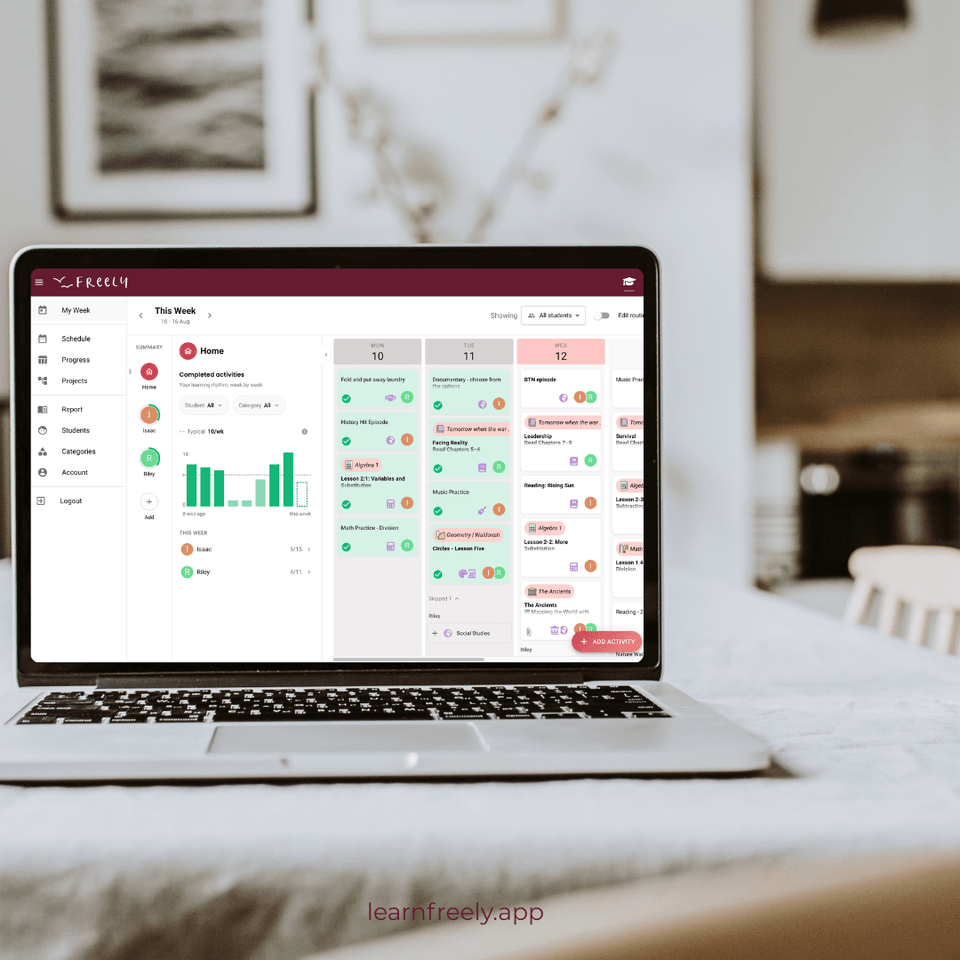
That’s why My Week is designed to move with you. Activities can be dragged and dropped between days as the week unfolds, without asking you to rebuild the whole plan every time something changes.
Because structure and control aren’t the same thing.
A Routine can give your week direction without demanding that Wednesday looks exactly the way you imagined it would on Sunday. Sometimes something needs to move. Sometimes something better takes its place. Sometimes you realise you simply don’t need to do it anymore.
The plan is still doing its job. It’s holding the direction while leaving enough space for the learning to remain alive inside it.
And then, step back
There’s another side to this balance. We don’t only need flexibility. As home educators, we also need to be able to step back occasionally and reassure ourselves that we really are moving forward.
When you’re standing in the middle of a messy week, that can be incredibly difficult to see. You remember the Maths lesson that didn’t happen yesterday. You notice you haven’t touched Science this week. You see the thing that is missing.
What you don’t always see is the learning that has been quietly accumulating around you.
That’s why we’ve created Learning Rhythm.
Learning Rhythm gives you a broader view of the learning that has taken place across recent weeks. It lets you zoom out and see the pattern, rather than judging everything by one day or one week.
Maybe Maths has actually been remarkably consistent. Maybe Science happens less frequently, but when it does, it takes over for days. Maybe Language Arts is appearing through reading, writing, projects and experiences much more often than you realised. Maybe Life Skills have quietly become one of the strongest parts of your child’s week.
The point isn’t to create another score to chase, and it isn’t for Freely to decide whether you’re doing enough.
We don’t think “enough” should be determined by a planner.
What we can do is help you see what’s there: the pattern, the progress, the areas that are thriving and the things you might want to bring back into focus. Then you decide what comes next.
Holding the journey without taking it over
%20(Instagram%20Post).png)
When we look at these changes together, they aren’t really separate features. They are different parts of the same idea.
Begin with the child. Create enough rhythm to give their week direction. Add detail where it is useful. Let the week move when life moves. Record the learning that actually happened. Then step back occasionally and see the pattern that has been forming.
For us, that is the art of homeschool planning: holding enough structure around a child’s education that they can keep moving, progressing and learning, without controlling every step of the way.
And perhaps that matters now more than ever.
Our children are growing up in a world being reshaped by AI, where access to information is changing rapidly and many of the tasks we once considered essential can increasingly be automated. What will continue to matter is the ability to think deeply, make connections, ask good questions, create, adapt and follow an idea somewhere unexpected.
We don’t believe the future belongs to children who have all been shaped to think in exactly the same way.
There is enormous value in the curious ones. The deep thinkers. The makers. The question askers. The children who follow an idea far beyond where the lesson was supposed to end. The ones whose interests don’t always fit neatly inside a timetable.
Home education gives us an extraordinary opportunity to protect that — to give our children direction without sanding away the parts of them that make them different.
Freely isn’t trying to become an enormous “all-in-one” system that asks home educators to manage more. We want to do something much more meaningful.
To help hold the space around a child’s education — enough structure for them to keep moving forward, and enough freedom for curiosity, individuality and possibility to keep growing inside it.
Because that is what home education gives us the freedom to do.
And it’s what we want Freely to protect.